
Meet Your Business Match
Calculate the return on your investment
So, you’re close to making the call on your new software, now learn how to calculate its ROI.

MYOB Advanced is now MYOB Acumatica
Understanding ROI calculations
Calculating cost vs benefit and return on investment (ROI) when you invest in a business management platform like MYOB Acumatica.
The return on investment (ROI) equation.
Buying and implementing new business software can be a significant undertaking – scoping out options, assessing features, implementation, staff training and the financial cost of the system itself.
That’s why investing in any new business software requires a robust return on investment (ROI) analysis. This can be a simple cost/benefit analysis or a more detailed assessment that takes multiple factors and potential impacts into consideration.
Measuring the potential impact of any new system should include not only financial metrics but also key factors such as improved customer experience, staff productivity and retention and better access to information, resulting in smarter decision-making and long-term growth.
The potential costs of sticking with an outdated system also need to be considered. This includes lost sales that may result from older, less efficient solutions. Technology has changed the way businesses serve and interact with their customers, and customer expectations have increased to match. If you can’t respond to your customers promptly, or provide the same services as your competitors, you will likely lose out.
On the operational side, loss of productivity can occur as a result of slower manual processes and frequent errors. Manual systems may require more staff to operate effectively, which also increases costs.
Less obviously – but more importantly – older systems can also have an impact on your decision-making and growth. Without insight into how your business is performing at any point, it’s difficult to make the right decisions around marketing, new products or services, staffing or anything else. It can also be difficult to react quickly as the market changes – if you can’t see trends as they happen, you can’t work quickly to take advantage of opportunities or avoid disasters.
A growing business requires swift and universal scalability throughout all business processes and functions. The rollout of any change must occur simultaneously, which can be challenging if you’re using an on-premise based system to service a mobile workforce.
A cloud-based system provides a competitive edge. It’s a complicated calculation, but it’s worth making the effort – after all, a business management system affects every part of your business.
When it comes to ROI, where do you start? At its most basic, ROI compares the cost of implementing a new system to the increase in profits that result. Of course, it’s not quite as simple as it sounds.
Working out the projected benefits includes looking at immediate savings as well as long term gains, which can be complicated to gauge before implementation.
Calculating the cost of a new system isn’t straightforward either – it involves looking at upfront and ongoing expenses, as well as the less obvious costs associated with a new system, like staff training, disruption during implementation and any new hardware or software needed.
There’s also the negative cost factor of not upgrading your system. This is even more difficult, and will usually involve estimates and assumptions.
Outdated solutions cost time, money and customers. Ineffective business and people management solutions negatively impact productivity, customer experiences and profitability. Midmarket firms reported an average 28% of extra costs due to inefficient and/or ineffective solutions.
Source: ‘Seizing Advantage: The Technology Pivot ANZ Businesses Must Make,’ MYOB commissioned study conducted by Forrester Consulting, August, 2021
Calculating cost savings and revenue boosts Estimating business benefits is a multi-part process. Clear cost savings include server expenses and the cost of paying for your current system. After that, it becomes more complex. Factors like increased productivity and reduced errors will have an impact on profitability, but it can be difficult to come up with a hard number that reflects the business benefit.
Cost-saving areas could include:
- Lower overheads for server management if you move to a cloud solution
- Tighter inventory management, saving time and reducing lost product
- Increased productivity, with the ability to automate manual, repetitive tasks
- Reduction of wasted materials thanks to efficient processes
- Less time spent on manual tasks, fewer human errors
- Better time management
- Features that improve customer experiences can also increase revenue – here’s how:
- Improved customer service means increased sales and retention
- More efficient processes can boost profit margins
- Better access to data allows for more agile, competitive pricing.
- Some benefits can be intangible and even harder to quantify, but still add value for your organisation.
Think about:
- Improved employee productivity and job satisfaction, resulting in higher staff performance and retention
- Better communication between departments, allowing for smoother delivery of products and services
- Continual access to accurate data to give you a competitive edge, helping you respond to changes in the market more quickly
A full breakdown of costs The cost of implementing and operating your software extends to more than just the pricing structure. Business management systems rely on the people that manage and use them along with other resources that are often not accounted for.
That’s why understanding the true cost of operating and maintaining your system is a necessary part of evaluating ROI.
There are five cost areas to consider:
- Hardware and core system software
- Application costs
- Additional systems or services
- People costs
- Ongoing costs
Hardware and core system software
Although cloud ERP systems don’t always require new hardware, you may need to purchase devices like smartphones, tablets or other technology to make sure you’re getting the full benefit. On-premise solutions will almost always require investing in backend hardware such as servers, which can be pricey to buy and maintain long-term.
Application costs
- Purchase or subscription costs
- First year’s maintenance
- User license fees (the number of user licenses must be sufficient for the number of
- Users who will need access to the new system)
Additional systems
- Integration and programming services
- Data storage and security
- Support services
People costs
The cost most commonly underestimated when implementing a new programme is the true cost of time for staff to implement and onboard other teams to a new system.
- Operational staff time for implementation
- Staff time for testing and adjustment
- Education and on-boarding of all teams to optimise use
- Specialty labour required for integration with remaining legacy systems
- Integration of mobile devices across the business
Ongoing costs
When your system is set up and in use, ongoing maintenance is essential. This is where cloud ERP systems deliver the most value as the ongoing maintenance is most often included in the subscription fees. For on-premise systems, make sure to factor in the ongoing costs of managing the performance and expansion of the system.
ROI: the final equation
Once you’ve added up the costs and benefits – including all the less obvious factors and ongoing costs – it’s time to work out your ROI. Of course, if the costs outweigh the potential benefits, there’s no value to your business, and it’s time to look for another solution.
There are two common ways to calculate ROI:
Method 1
Divide total benefits by total costs
Divide the total projected benefits associated with the new software by the total costs, and remember to match the times. That is, if you’ve calculated benefits for the next five years, also add up costs for that period.
For example
Total benefits: $150,000
Total costs: $30,000
ROI: $150,000/$30,000 = 5 or 500%
Method 2
Divide net profit by total costs
Your net profit is the total projected benefit, minus the cost of your new system. When you have this, you divide it by the cost to find your overall ROI.
For example
Total benefits: $150,000
Total costs: $30,000
Net profit: $120,000
ROI: $120,000/$30,000 = 4 or 400%
Although ROI isn’t the only factor to consider when choosing a software system, it’s an important measure of the value to your business, and should be carefully considered.
MYOB Acumatica – costs, benefits and considerations
MYOB Acumatica is a fully integrated cloud business management platform that can facilitate operations across your business, from administration to warehouse management to distribution. With comprehensive accounting, finance and cash-flow forecasting systems, it’s a powerful driver for efficiency and business growth.
Of course, deciding to switch to MYOB Acumatica or any other cloud ERP system will involve looking at the potential benefits – as we’ve seen. The system delivers a host of features, each with potential value to your business. Some will be obvious at a glance and other factors may be less tangible.
Here’s how the features stack up – and what they can deliver in value:
Enhanced inventory management
Automated tracking, sales and purchase orders and more means more efficient processes and reduced product loss.
Sales and purchasing
Track orders, sales and deliveries through a single system for improved efficiency and better customer service.
General ledger and accounting support
With all your sales and purchase data feeding into your general ledger, it’s far easier to track overall expenses and create EOFY reports.
Finance, budgets and cash-flow forecasting
Smart reporting and forecasting tools let you manage cash flow and make informed business decisions.
Comprehensive Project Management
Track and tweak every aspect of a project through one platform, with remote access for all your team members.
Superior CRM
Manage and monitor customer information, measure sales techniques and improve customer service.
Customisable dashboards
Set metrics to suit your business processes and goals, and access through a smart, up-to-date daily dashboard.
Cost calculations
You’ll also need to look at the costs associated with MYOB Acumatica. It’s a feature-heavy platform, but because it’s cloud-based, there’s no need for additional hardware or on-premise technology.
A SaaS system, MYOB Acumatica is paid for on a subscription basis with ongoing support built-in. This makes it relatively easy to add up the costs after implementation.
Choosing your next business management platform
When weighing up your business software options, ROI will be one of the primary considerations. Because it’s so important, it’s worth making the effort to add all the benefits with a concrete dollar value, as well as less tangible factors.
Considering a broader cost/benefit analysis will factor in the less tangible benefits – customer satisfaction, improvements in efficiency and a happier, more dynamic and flexible workforce.
It’s also crucial to consider the cost of complacency – outdated software can limit growth and stifle productivity, with significant, but often unnoticed, costs over time.
Forrester found that organisations with future fit platforms and practices grew 3.2x faster than their industry peers.
Source: “Beyond Agility – Adaptive Enterprises Hold The Winning Hand,” Forrester Research, Inc., May 7, 2019
Building value with MYOB Acumatica
MYOB Acumatica offers a wide range of benefits in a unified package.
It’s a single, cloud-based system with remote access and tools designed to automate and streamline systems throughout your business and give you a clear, accurate view of your business data.
Because MYOB is based in Australia and New Zealand, access to implementation partners and ongoing support services is simple, so it’s easier to make the most of your investment.
When you put those benefits against the cost of investment, and the potential costs of sticking with older, clunkier software, the choice is clear.
Outdated solutions cost midmarket businesses time, money and customers. Building a business case for investment in MYOB Acumatica is as simple as highlighting the costs of standing still while your competition moves forward.
The tangible returns in productivity and growth will help you sprint while competitors jog. The intangible benefits will ensure operational excellence and undeniable results.
Your company is ready to level up, so give it the power it deserves and upgrade to MYOB Acumatica.


Edition 1: Ambition
Edition 2: Tech
Edition 3: Risk
Edition 4: Change
Edition 5: Commitment
Keep on learning

Article
Growth of progress: why it's a win-win
We discuss how accelerating your software doesn’t mean more, more, more, it just means doing work better.
Video
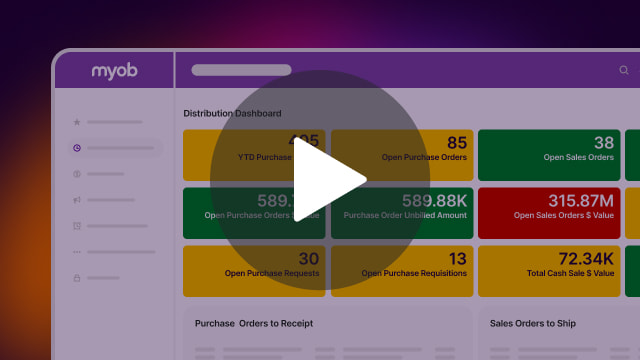
MYOB Acumatica in action
This real-time demo shows you just how powerful MYOB can be.
Resource
Calculate the return on your investment
So, you’re close to making the call on your new software, now learn how to calculate its ROI.